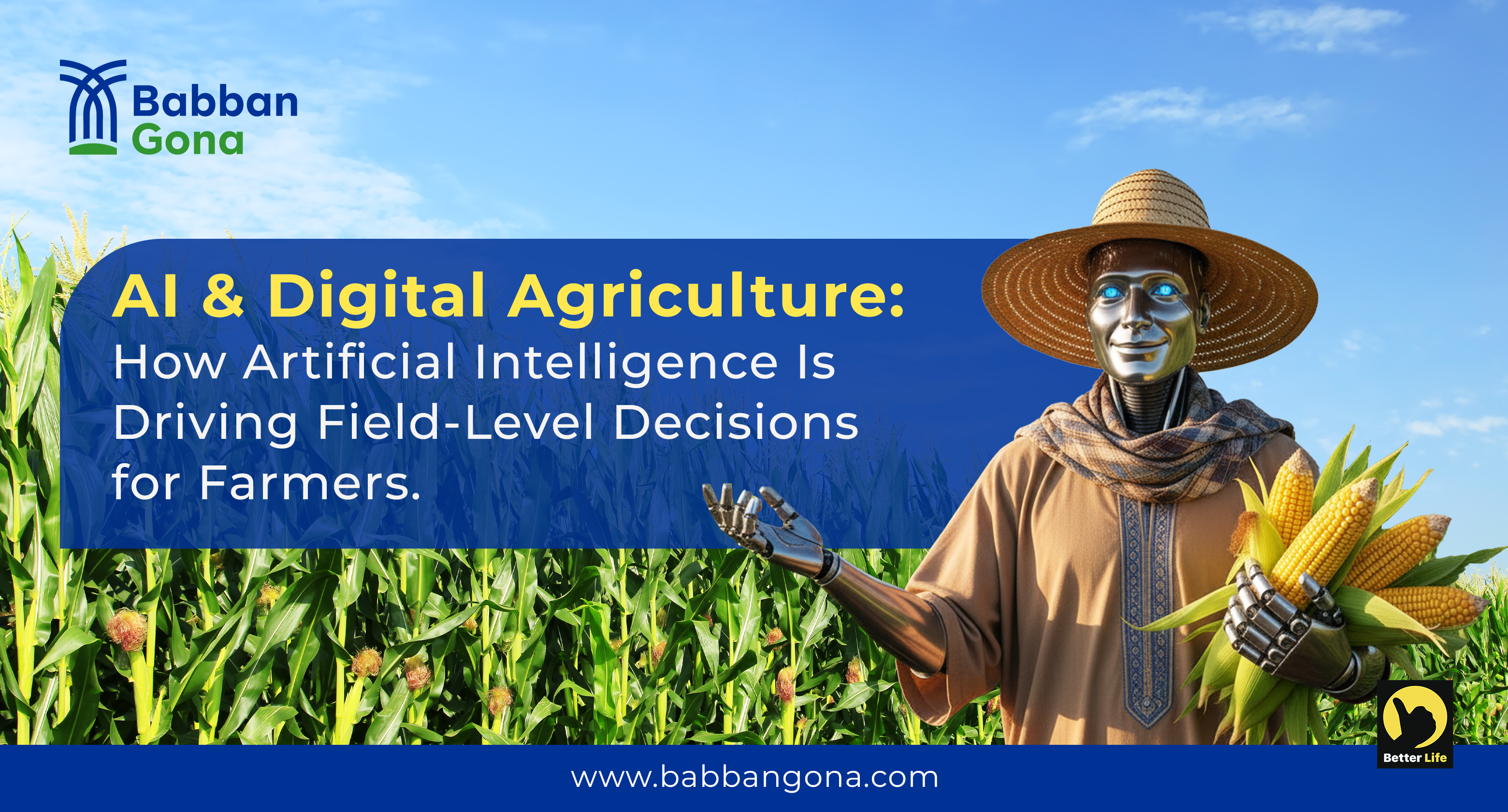
AI & Digital Agriculture: How Artificial Intelligence Is Driving Field-Level Decisions for 

For generations, farming decisions were guided by experience; reading the soil by touch, watching the skies, and applying knowledge passed down over time. While this intuition remains invaluable, today’s farmers are operating in a far more complex environment shaped by climate variability, rising input costs, and market uncertainty.

This is where Artificial Intelligence (AI) and digital agriculture are beginning to play a transformative role, supporting farmers with timely, data-backed insights that strengthen decision-making at the field level.

From Experience-Based Farming to Intelligence-Driven Agriculture

Modern agriculture is no longer just about what has worked before; it is increasingly about what will work best now. AI enables this shift by analyzing large volumes of agricultural data such as soil characteristics, weather patterns, crop performance, and field observations and translating them into practical guidance.

At Babban Gona, digital agriculture is not about replacing the farmer’s knowledge. It is about augmenting it, ensuring that every decision from planting to harvest is informed, precise, and context-specific.

How AI Supports Field-Level Decisions

  1. A “Digital Agronomist” Supporting Farmers on the Ground

Through digital tools and data-driven advisory systems, farmers can now receive agronomic recommendations that are tailored to their specific fields. For example, field data and visual assessments can help identify early signs of nutrient deficiencies or pest pressure, allowing for early and targeted interventions.

This reduces unnecessary chemical use, lowers production costs, and protects crop health while still relying on human extension support to guide final decisions.

  1. Precision Input Use

Traditional farming often relies on generalized advice: one fertilizer rate, one planting window, one approach for all. AI helps move beyond this by factoring in soil condition, crop type, and historical yield data to recommend appropriate input levels for specific locations.

This precision improves efficiency, supports soil sustainability, and ensures farmers apply only what is needed, no more, no less.

  1. Smarter Weather and Climate Planning

Unpredictable weather remains one of the biggest risks facing smallholder farmers. AI-powered climate analysis supports better planning by identifying trends and potential risks, helping farmers decide when to plant, irrigate, or harvest.

These insights contribute to stronger climate resilience, particularly in regions where rainfall variability directly impacts yields.

  1. Yield Forecasting and Better Farm Planning

AI models can estimate expected yields based on field conditions and crop performance trends. These insights support better planning, helping farmers make informed decisions about storage, aggregation, and market engagement.

Making AI Work for Smallholder Farmers

Technology alone does not transform agriculture; access, relevance, and trust do. Digital tools are most effective when they are simple, localized, and integrated with human support systems.

At Babban Gona, AI-driven insights complement field officers, training programs, and farmer networks, ensuring technology works for farmers, not the other way around.

The Future of Intelligent Farming

As digital agriculture continues to evolve, AI will play an even greater role in shaping sustainable and inclusive food systems. From personalized advisory to improved risk management, intelligent tools will help farmers navigate uncertainty with greater confidence.

By enabling smarter field-level decisions, Babban Gona continues to move closer to its mission of empowering farmers to build resilient livelihoods and prosperous communities.


Leave a Comment

Your email address will not be published. Required fields are marked *

bg-logo

Stay in touch with us

Subscribe to our newsletter to receive Babban Gona's Blog updates.

Frank Altman

Non-Executive Director

Pioneer of secondary markets for community development and $3.5B+ in managed funding.

Frank Altman is the founder and first CEO of the Community Reinvestment Fund (CRF), USAwhere he pioneered secondary markets for economic development loans. Under his leadership, CRF funded over $3.5 billion in loans across 50 U.S. states. He was instrumental in designing the federal New Markets Tax Credit and is an advisor to the Federal Reserve Bank of San Francisco.

Altman is an Ashoka Senior Fellow and the author of A New Capitalism: Creating A Just Economy That Works For All. He brings global expertise in risk management and capital structures to Babban Gona.

Michael Jainzik

Independent Non-Executive Director

Michael Jainzik works as an independent consultant and brings his extensive expertise in the areas of agricultural finance, international investments, risk management and corporate governance. He is currently based in Rome, Italy.
 
From 2001 to 2011, Michael worked as an investment professional at KfW Development Bank, focusing on international debt financing and equity investments in investment funds and banking institutions, mainly in the areas of agricultural finance and microfinance. From 2011 to 2015 he worked as Director of KfW’s office in Windhoek. In this role, he helped manage and develop KfW’s EUR 250 million portfolio in Namibia. From 2015 to 2017, he took on the position of Head of Corporate Development at Access Microfinance Holding, where he was responsible for structuring and leading a merger process between Access Holding and another company.
 
Prior to joining Babban Gona, Michael served as a non-executive director in Access Bank Azerbaijan (2006-2011, Chairman), Belarusian Bank for Small Business (2008-2011), Rural Impulse Fund II Luxemburg (2010-2011) and AB Bank Zambia (2011-2016).
 
Michael studied economics and management at the Universities of Lüneburg and Witten/Herdecke (Germany) and at ETEA – Universidad Loyola in Córdoba (Spain) and holds a Master’s degree in economics and management.

Alhaji Bello Maccido

Board Chairman

Over 32 years of executive leadership in corporate and investment banking.

Alhaji Bello Maccido is a distinguished leader in the Nigerian financial services sector. He currently serves as the Chairman of FBN Merchant Bank Ltd. and has previously held board positions at FBN Holdings Plc, First Bank of Nigeria Plc, and Legacy Pension Manager Limited.

He holds the traditional title of “Wakilin Sokoto” and is a Fellow of both the Chartered Institute of Stockbrokers and the Chartered Institute of Bankers of Nigeria.

Alhaji Maccido’s educational background includes an LL.B from Ahmadu Bello University and an MBA from Wayne State University. He is a Barrister at Law (BL) of the Supreme Court of Nigeria and an alumnus of executive programs at Harvard Business School and IMD Lausanne.

Muhammad Sanusi, CON

Chairman of the Board

His Highness Muhammad Sanusi was appointed the 10th Governor and Chairman of the Board, Central Bank of Nigeria on 3 June 2009. He earned Bachelor’s and Master’s degrees in Economics from the Ahmadu Bello University, Zaria, and also has a first-class degree in Sharia and Islamic Studies from the African International University, Khartoum, Sudan.
 
From working as a lecturer at the Ahmadu Bello University, where he taught Economics, he joined the banking industry in 1985, and by January 2009 had risen to General Manager and Group Managing Director of First Bank of Nigeria PLC, Nigeria’s oldest and biggest bank. Mallam Sanusi has been conferred with a National Award of Commander of the Order of the Niger (CON) by the President of the Federal Republic of Nigeria and has also been awarded the “Global Central Bank Governor for 2010” by The Banker Magazine, a publication of the Financial Times.
 
He was also voted Central Bank Governor of the Year for Sub-Saharan Africa 2009 (an award he won again in 2010) by Emerging Markets, a publication of Euromoney Institutional Investors. In 2011, Mr. Sanusi was named Forbes Africa Person of the Year for 2011. He was also listed by TIME Magazine as one of the 100 most influential people in the world. Kola Masha (Managing Director) Prior to Babban Gona, Kola was a Managing Director and CEO of a major subsidiary in the Notore.

Lola Masha

Non-Executive Director

Dr. Lola Masha is a seasoned technology leader with over 15 years of experience at the intersection of mobility, technology, and agriculture. She currently serves as a Partner at Antler, a global early-stage venture capital firm. Previously, she was the Regional General Manager for North, East, and West Africa at Bolt, overseeing strategic operations in a high-growth mobility sector.

Her career includes leadership roles as Director of Trust and Safety at OLX Group (overseeing 30+ markets) and Country Manager for OLX Nigeria. She was also one of the earliest employees at Google Sub-Saharan Africa. Dr. Masha holds a PhD in Chemical Engineering from the University of California, Berkeley, and a B.Sc. from the University of Virginia.

Kola Masha

Managing Director

First leader of a for-profit social enterprise to win the Skoll Award for Social Entrepreneurship.

Prior to co-founding Babban Gona, Kola was CEO of a subsidiary in the Notore Group, where he led a commercial strategy to sell one million tons of fertilizer and raised $130 million in equity.

He has held leadership roles at GE and Abiomed and served as a Senior Advisor to the Nigerian Minister of Agriculture.

Under his leadership, Babban Gona became the first for-profit social enterprise to win the prestigious Skoll Award for Social Entrepreneurship, recognizing the organization’s innovative approach to transforming smallholder farming in Nigeria.

He holds an MBA with Honors from Harvard and a Master’s in Mechanical Engineering from MIT.

Kola Masha


Prior to Babban Gona, Kola was a Managing Director and CEO of a major subsidiary in the Notore Group, one of Nigeria’s leading agricultural conglomerates, where he raised US$24 Million to develop an integrated agricultural trading, production and processing business.

Furthermore, he led the development and execution of Notore’s commercial strategy across West and Central Africa, preparing the company to sell one million tons of fertilizer and establish a modern seed business.

He led the effort to raise $130 million in equity and the restructuring of $360 Million in debt. Kola brings significant leadership experience in venture capital, corporate finance, business development, marketing and operations, across four continents with multiple global companies, including GE, Notore and Abiomed. In addition, Kola brings extensive public sector experience as Senior Advisor to the Nigerian Minister of Agriculture.

In recognition for his leadership in driving positive change on the African Continent, he has received several global awards including the prestigious Eisenhower Fellowship, a leading leadership institute led by General Collin Powell and appointed to the Board of the African Enterprise Challenge Fund, a $250 Million fund that awards grants and repayable grants to private sector companies to support innovative business ideas in agriculture, agribusiness, renewable energy, adaptation to climate change and access to information and financial services. Kola holds an MBA (Honors) from Harvard and a Masters in Mechanical Engineering from the Massachusetts Institute of Technology.