
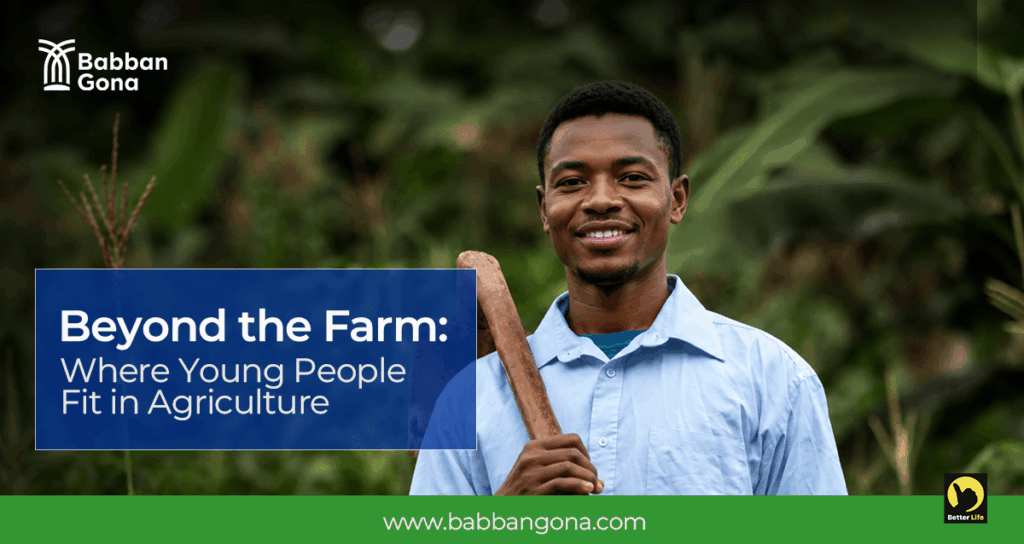
Nigeria has one of Africa’s largest and youngest populations, yet agriculture is still too often seen as an industry young people should move away from, rather than one they can help transform.
For many young Nigerians, agriculture still brings to mind a familiar picture: farming as a physically demanding occupation, dependent on land, weather, and uncertain returns. But agriculture is much bigger than what happens on a farm.
Behind every harvest is an entire ecosystem of businesses and professionals working across finance, technology, logistics, processing, research, and marketing. As this ecosystem evolves, so do the opportunities within it.
This means a young person interested in finance, technology, business, data, engineering, or entrepreneurship does not have to choose between their interests and agriculture. There is room for all of these skills in the sector.
Making Agriculture a Business
For these opportunities to grow, farming itself has to be a viable business.
Smallholder farmers often face challenges including limited access to finance, quality inputs, technology, training, and reliable markets. Addressing these gaps is critical to making agriculture an attractive and sustainable business.
At Babban Gona, our farmer franchise model is built around this idea. By providing farmer members with financing, quality inputs, training, technology, and market access within a structured system, we support them in running their farms as profitable businesses.
The results show what is possible. Babban Gona farmer members achieve profitability roughly 2.5 times the national average, demonstrating the potential that can be unlocked when farmers have access to the resources and support they need.
Where Technology Meets Agriculture
As more young people pursue careers in technology, there is an opportunity to look beyond the idea that technology and agriculture are separate paths.
Technology is only as valuable as the problems it helps solve. Agriculture presents some of the most important problems to solve: how to improve productivity, expand access to finance and information, connect farmers to markets, manage data, and make agricultural businesses more efficient.
At Babban Gona, we have seen this intersection play out in practice. Technology is part of how we support our farmer members, helping us manage information, deliver services, monitor activities, and strengthen the systems that enable farmers to operate more productively and profitably.
This creates an interesting opportunity for young people. A software developer can build solutions for farmers. A data analyst can help turn agricultural data into better decisions. An entrepreneur can use technology to improve logistics or market access.You do not have to choose between technology and agriculture. You can use one to transform the other.
Building What Comes Next
Agriculture is not simply an industry that needs more people to farm. It needs people who can build businesses, develop solutions, improve systems, and create value across the entire value chain.
A young entrepreneur could build a logistics business that connects farms to markets. A finance professional could develop products designed around the realities of agricultural businesses. Someone interested in food and manufacturing could create new ways to process agricultural products and add value. And, of course, a young person can choose to become a farmer; approaching farming not simply as an occupation, but as an enterprise that can be managed, scaled, and grown.
Nigeria’s agricultural sector still faces significant challenges, but those challenges also represent opportunities to build something better. The next generation of agricultural businesses may look very different from the ones we know today, combining farming with technology, finance with data, and food production with innovative approaches to processing and distribution.
Young people do not have to wait for that future to arrive. They can help create it.