
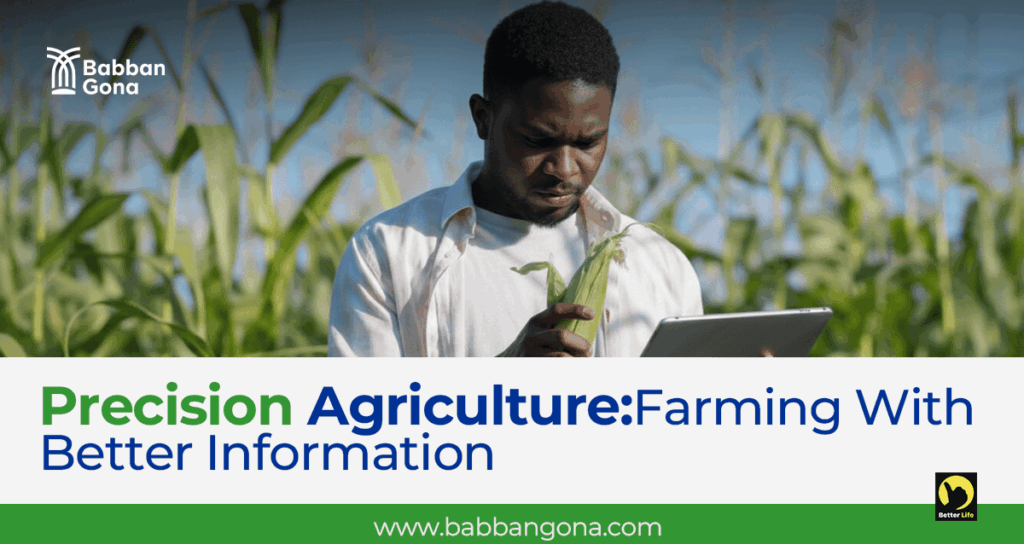
Nigeria imports a significant share of the food it consumes. Not because the land cannot produce it, but because smallholder farm productivity has never reached its potential. Closing that gap does not require a revolution. It requires better information.
That is the core of precision agriculture: giving farmers the knowledge to apply the right input, in the right amount, at the right time, in the right place.
The Problem With the General Approach
For generations, farming in Nigeria has relied on what we might call the uniform method: the same fertilizer rate across the whole field, the same pest management strategy everywhere, and the same planting schedule regardless of local conditions. It is the way things have always been done.
But no two patches of soil are identical. Rainfall does not fall evenly across a farm. Pest pressure shifts from one plot to the next. Inputs that work brilliantly on one farmer’s land can be wasteful or even harmful when applied the same way somewhere else.
The uniform approach is not laziness. It is the rational response to an absence of information. Precision agriculture changes what information is available.
What Precision Agriculture Actually Means
Precision agriculture is the practice of treating a farm not as a single unit, but as a collection of zones each with its own needs, its own strengths, and its own room for improvement.
At its most basic, this might mean using soil test results to guide fertilizer use rather than guessing. At a more advanced level, it can involve weather advisory platforms, mobile agronomic support, and digital farm records that help farmers spot patterns and make smarter decisions season after season.
The goal is consistent: more output, less waste, and a farm that improves year over year, not one that simply survives the current season.
Two Ways Precision Agriculture Improves Profitability
Smallholder farmers in Nigeria operate on tight margins. Precision agriculture improves profitability from both directions simultaneously.
On the efficiency side: when fertilizer is applied based on what the soil actually needs, when seeds are matched to local conditions, when pest management targets genuine threats rather than guarding against every possibility, yields improve without costs rising proportionally.
On the waste side: over-fertilization, unnecessary pesticide use, poorly timed planting, these are common and expensive mistakes. Better data prevents them. For a farmer working on narrow margins, the savings from not wasting inputs can be as significant as the gains from higher yields.
How We Apply This at Babban Gona
Precision agriculture does not have to mean satellites and algorithms. For the smallholder farmers we work with, it means something more immediate: farming with more information and more intentional support than they have ever had before.
Our agronomic guidance is not generic advice handed out uniformly. It is grounded in the specific conditions each farmer is working with, the soil health in their region, local weather patterns, and the pest and disease pressures most relevant to their area. Our input provision follows the same logic: quality inputs matched to what each farmer’s land actually needs, with training on correct application rates and timing so nothing is wasted.
When farmers across Nigeria are empowered to farm more precisely, the cumulative impact is significant: less waste, more output, stronger incomes, and a meaningful contribution to the food security challenge Nigeria has been trying to solve for decades.
That is the future we are working towards. One farm, one better decision at a time.